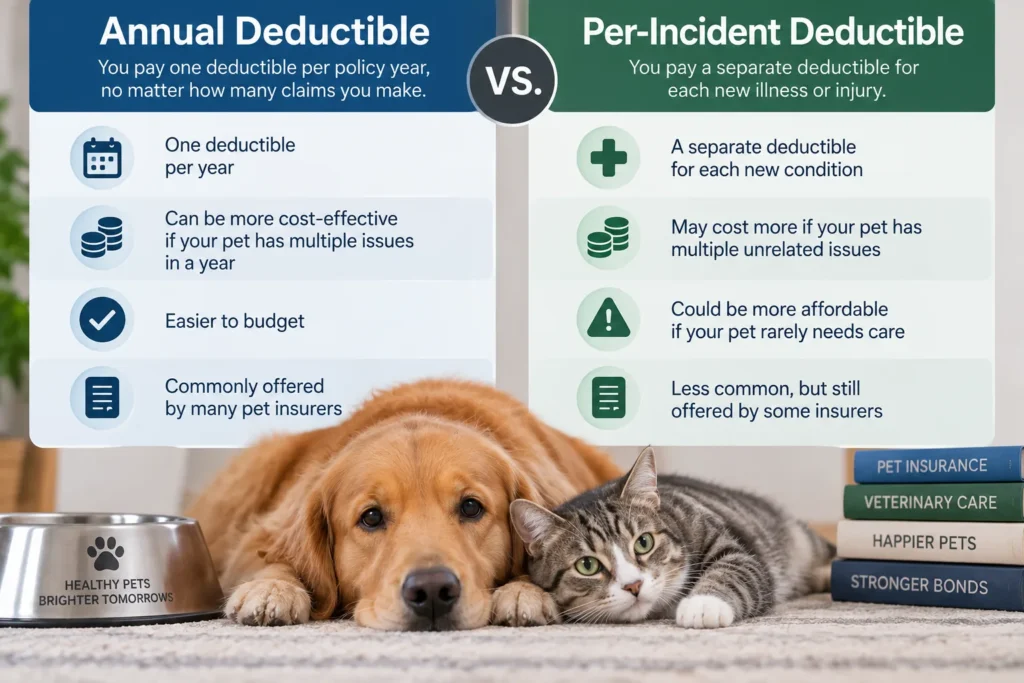
Two policies can list the exact same dollar amount as a “deductible” and behave in completely different ways depending on which structure sits behind that number. The annual vs per-incident deductible distinction is one of the most consequential, and least understood, details in a pet insurance policy. Here’s a direct, side-by-side look at how each one actually plays out.
The Two Structures, Side by Side
| Annual Deductible | Per-Incident Deductible | |
|---|---|---|
| How often you pay it | Once per policy year, regardless of claim count | Once per new/distinct medical condition |
| Resets | Every policy year | Never resets for that same condition, even across years |
| Best for | Pets with multiple, unrelated health issues in a year | Pets with one ongoing chronic condition |
| Predictability | High — you know the total once met | Low — depends how many new conditions arise |
| Availability in 2026 | Industry standard; most insurers use this | Less common; check which type a plan uses |
How Annual Deductibles Actually Behave
You pay a set amount once, the first time you file a claim in a given policy year. From that point through the rest of the year, insurers reimburse every eligible claim, regardless of whether it’s a repeat of the same issue or something completely unrelated, at your policy’s percentage rate with no further deductible required. When your policy renews, the deductible resets and the cycle starts again. Embrace explains that annual deductibles are more predictable, since you only need to meet your deductible once per policy term regardless of how many separate incidents occur.
Where this structure shines: a dog that has an ear infection in March, eats something toxic in June, and needs a dental extraction in October has effectively paid one deductible for the entire year of otherwise unrelated problems.
How Per-Incident Deductibles Actually Behave
You pay a separate deductible for each new, distinct condition your pet gets diagnosed with. Once you’ve paid it for that specific condition, though, you never pay it again for that same condition, even in future policy years. A dog diagnosed with hip dysplasia pays the deductible once at diagnosis; ongoing treatment for that same condition in later years only requires your reimbursement-rate share, not another deductible. Progressive confirms that a per-incident deductible applies every time you file a claim for a new condition, distinct from the annual model.
Where this structure shines: a pet with a single, well-defined chronic condition (diabetes, a hereditary joint issue) that will require treatment for life effectively “pays off” that condition’s deductible once and stays protected on it permanently.
Annual vs Per-Incident Deductible: The Trade-Off in One Sentence
Annual deductibles protect you against having a bad, varied year. Per-incident deductibles protect you against having one expensive, recurring problem. Almost no pet fits neatly into just one of these patterns, which partly explains why the industry has moved so decisively toward the annual model as the default.
Why Per-Incident Deductibles Have Nearly Disappeared
This point is worth stating plainly: per-incident deductibles are now the less common structure, and most plans you compare will use an annual deductible. This shift likely reflects both simplicity (annual deductibles are easier for customers to understand and predict) and risk management on the insurer’s side, since a per-incident structure creates more unpredictable exposure for insurers covering pets with several unrelated conditions in a single year.
A Side-by-Side Cost Comparison
Same dog, same year, three separate medical events — chocolate toxicity ($600), an ear infection, and a cruciate ligament tear ($3,900) — reimbursed at 80%:
- Annual deductible ($200, paid once): You pay the deductible with the first claim ($200 + 20% of the remaining $400 = $280 for the toxicity); insurers reimburse every subsequent claim that year at 80% with no additional deductible (20% of $3,900 = $780 for the ligament tear). That’s the same $1,060 across those two incidents, and the ear infection carries no further deductible.
- Per-incident deductible ($100 per condition): $100 + 20% of the remaining $500 = $200 for the toxicity, plus $100 + 20% of the remaining $3,800 = $860 for the ligament tear. That’s a combined $1,060 across two of the three incidents, and the ear infection adds a third $100 deductible on top.
The two structures tie on the two large claims, and the annual structure pulls ahead once the third condition is claimed, precisely because this dog had multiple unrelated issues rather than one recurring condition. That’s the exact scenario where the per-incident structure performs worse.
When Per-Incident Would Actually Win
Flip the scenario: imagine a dog diagnosed with a single chronic skin allergy condition that flares up and requires treatment four times over two years, with no other health issues at all.
- Per-incident deductible: You pay the deductible once, at the first flare-up. The remaining three treatments across two years only require your reimbursement-rate share, no further deductible ever, for that condition.
- Annual deductible: If those flare-ups happen to straddle two different policy years, you’d pay the annual deductible twice, once in each policy year the condition gets treated, even though it’s the same single condition throughout.
This is the scenario per-incident deductibles were actually built for, and it offers a genuine advantage where it applies. The practical challenge is that most insurers no longer offer it as an option to select.
What This Means for Choosing a Policy Today
Since the market has moved so heavily toward annual deductibles, the realistic decision for most pet owners in 2026 isn’t “which structure should I choose.” It’s simply which dollar amount of annual deductible fits your budget and risk tolerance. If you do come across an insurer still offering a genuine per-incident option, take a closer look specifically if:
- Your pet already has one diagnosed chronic condition and is otherwise healthy.
- You’re comparing quotes and this insurer’s premium runs meaningfully lower, which sometimes reflects the different risk structure.
- You’re comfortable with less predictability in exchange for permanent protection on a specific known condition.
For most other situations, like a young, healthy pet with an unknown future health profile or an older pet at higher risk of developing several different age-related issues, the now-standard annual deductible structure generally offers the more favorable and more predictable option. Our pet insurance reimbursement rate guide covers how the deductible interacts with your reimbursement percentage on an actual claim.
Bottom Line: Annual vs Per-Incident Deductible
Annual deductibles, paid once per policy year regardless of how many separate issues arise, have become the clear industry standard. They generally favor pets that end up with multiple, unrelated health problems in a given year. Per-incident deductibles, paid once per condition but never again for that same condition, can be genuinely advantageous for a pet with a single ongoing chronic issue. They’ve become rare enough in today’s market, though, that most pet owners will simply choose a dollar amount within the standard annual model rather than choosing between the two structures at all.
Frequently Asked Questions
If my insurer only offers annual deductibles, am I missing out on a better option? Not necessarily. Annual deductibles are the industry standard for good reason, and they tend to work out favorably for pets facing more than one type of health issue over the course of a year, which describes most pets over time.
Can a policy switch me from per-incident to annual, or vice versa, at renewal? This depends entirely on your specific insurer’s policy terms. Ask directly if you have a per-incident policy and want to understand whether that structure is guaranteed to continue at renewal.
Is one structure cheaper overall than the other? Neither is inherently cheaper. The better deal depends on your pet’s actual health pattern over the policy year. A pet with several unrelated issues does better under annual; a pet with one persistent chronic condition can do better under per-incident, where it’s still available.
Sources referenced: Embrace and Progressive (2025-2026 reporting).