Of all the terms on a pet insurance quote, the deductible is the one most likely to be misunderstood. It’s not because it’s complicated; two very different deductible structures exist and get used interchangeably in casual conversation. Getting your pet insurance deductible straight before you buy a policy meaningfully changes what you’ll actually pay when your pet needs care.
The Basic Definition of a Pet Insurance Deductible
A pet insurance deductible is the amount you pay out of pocket before your insurance starts reimbursing eligible veterinary costs. MoneyGeek’s 2026 deductible guide says deductibles range from $0 to $1,000, with $100, $250, $500 and $1,000 the common options and $500 often recommended as a sweet spot for healthy pets for balancing out-of-pocket costs against premiums. You select this amount when you buy your policy, and it directly trades off against your monthly premium: a lower deductible means a higher premium, and vice versa.
The Order of Operations Matters
Once you meet your deductible, the insurer pays a percentage of remaining eligible costs based on your reimbursement rate, commonly 70%, 80%, or 90%. Most insurers apply the deductible before calculating your reimbursement percentage, though some apply it after. This order actually changes your payout:
- Deductible applied first: ($3,000 bill − $500 deductible) × 80% = $2,000 reimbursed.
- Deductible applied after the percentage: ($3,000 bill × 80%) − $500 deductible = $1,900 reimbursed.
The difference looks modest in this example, but confirm which method your specific insurer uses, since it can meaningfully shift your reimbursement on larger claims.
The Two Pet Insurance Deductible Structures: This Is the Part That Actually Matters
Genuine confusion sets in here, because these two structures behave completely differently over the course of a policy year.
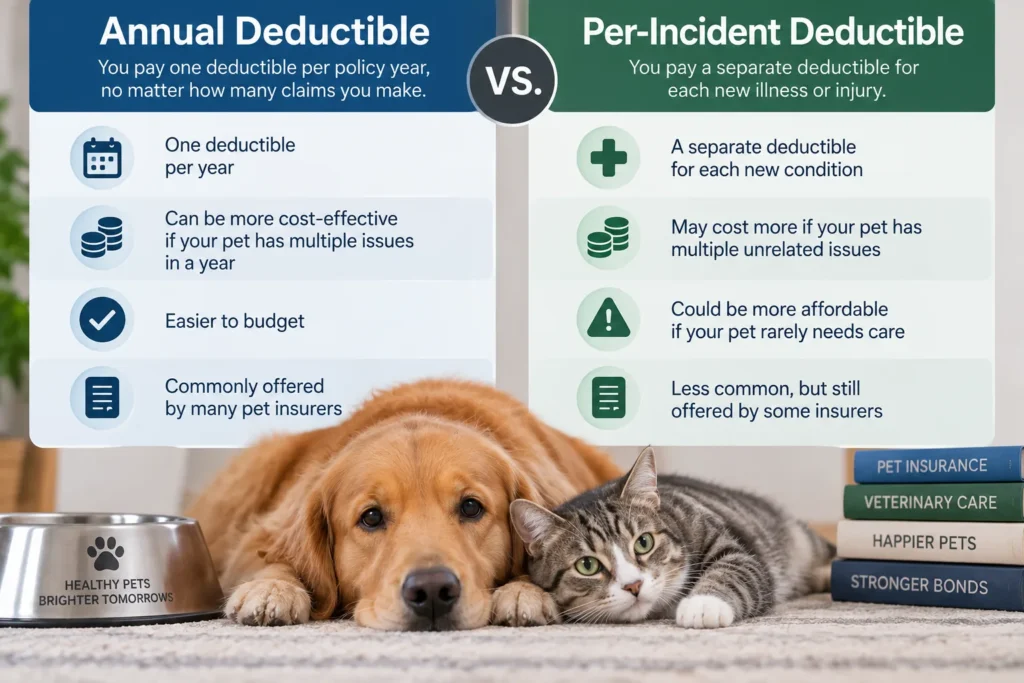
Annual Deductible (the industry standard)
You pay this amount once per policy year, regardless of how many separate claims you file. Once you meet it, the insurer reimburses eligible expenses for the rest of that policy period without requiring another deductible payment, even if your pet gets treated for three unrelated issues in the same year. The industry has largely standardized around this structure, and it’s what the large majority of pet owners will encounter today.
Per-Incident (or Per-Condition) Deductible
You pay a separate deductible for every new, distinct medical condition your pet experiences. Critically, though, once you’ve paid it for a specific condition, you generally don’t pay it again for that same condition, even in future policy years. This structure is now the less common one. It’s still worth understanding, though, since it behaves so differently from the now-standard annual model. Our full comparison of annual vs. per-incident deductibles walks through more scenarios in depth.
A Real Numbers Example: Same Pet, Different Outcomes
Here’s how the two structures play out for the same dog with three separate medical events in one year: chocolate toxicity ($600 bill) in March, an ear infection in May, and a cruciate ligament tear ($3,900 bill) in July, using 80% reimbursement in both scenarios, with a $200 annual deductible in one and a $100 per-condition deductible in the other:
With an annual deductible ($200, paid once): You pay the $200 deductible only with your first claim of the year. Insurers reimburse every subsequent claim that same year at 80% of the bill with no further deductible. That’s a more predictable cost when a pet has several unrelated issues in one year.
With a per-incident deductible ($100 per condition):
- March (chocolate toxicity): $100 deductible + 20% of the remaining $500 = $200.
- July (cruciate ligament tear, a new condition): $100 deductible + 20% of the remaining $3,800 = $860.
- Total across these two incidents: $1,060, the same as the annual-deductible scenario ($280 in March, then $780 in July). The per-incident plan only becomes more expensive once the ear infection is claimed too, because that third condition triggers another $100 deductible.
Here’s the trade-off: under the per-incident model, if the ear infection recurs next year, you won’t pay a new deductible for it, since you already met that specific condition’s deductible previously. That’s a real advantage for pets with one ongoing chronic issue, but a real disadvantage for pets with multiple unrelated problems in a single year.
Which Pet Insurance Deductible Structure Is Better?
- Annual deductibles favor pets with multiple, varied health issues in a given year. You get a predictable, one-time cost regardless of how many separate problems come up.
- Per-incident deductibles can favor pets with a single chronic condition requiring ongoing treatment. You pay once for that condition and then only your reimbursement-rate share going forward, for life. The downside is genuine unpredictability, since you never know in advance how many separate new conditions might emerge in a given year, each triggering its own deductible.
Given how rare per-incident deductibles have become, most pet owners today choose primarily between different dollar amounts of an annual deductible, not between the two structures.
How to Choose the Right Pet Insurance Deductible Amount
- Lower deductible ($100-$250): higher monthly premium, but less out-of-pocket exposure at claim time. Often a reasonable choice if you’d struggle to cover a few hundred dollars unexpectedly, or if you expect frequent claims.
- Higher deductible ($500-$1,000): lower monthly premium, but more exposure per claim. This can make sense if you have a healthy pet, a solid emergency fund, and want to minimize ongoing premium cost in exchange for handling more of a large bill yourself when it happens.
What Doesn’t Count Toward Your Deductible
Routine, preventive care, like vaccines and annual wellness exams, generally doesn’t count toward your pet insurance deductible at all under a standard accident-and-illness policy, since that kind of care isn’t covered by the base policy in the first place. Only costs tied to a covered accident or illness apply toward meeting your deductible.
Does Your Deductible Affect What’s Covered?
No. This point is worth stating directly, since it’s a common source of confusion: your deductible affects your costs, not your coverage. Choosing a higher or lower deductible doesn’t change which conditions or treatments are eligible for reimbursement. It only changes how much you pay out of pocket before that reimbursement kicks in.
Bottom Line on Pet Insurance Deductibles
A pet insurance deductible is the amount you pay before reimbursement starts, chosen at the time you buy your policy from a typical range of $100-$1,000. The structure matters as much as the dollar amount. Annual deductibles, now the industry standard, get paid once per year regardless of how many unrelated issues arise. The increasingly rare per-incident structure charges a separate deductible for each new condition but never charges twice for the same one. For most pet owners today, the real decision is simply choosing the deductible amount that best balances a manageable monthly premium against how much you’re comfortable paying out of pocket if your pet needs care.
Frequently Asked Questions
Does my deductible reset every time my pet gets sick? Under the now-standard annual deductible structure, no. You pay it once per policy year regardless of how many separate issues come up. It only resets when your policy renews for a new year.
Is a per-incident deductible better or worse than an annual deductible? It depends on your pet’s situation. Per-incident can work better for a single ongoing chronic condition, since you pay once and then only copays for life on that condition. It works worse if multiple unrelated issues arise in one year, since each triggers its own deductible.
Does choosing a higher deductible mean less coverage? No. Your deductible only affects how much you pay out of pocket before reimbursement starts, not which conditions or treatments your policy covers.
Sources referenced: MoneyGeek (2025-2026 reporting).