Dental cleaning is one of the most consistently underestimated costs of dog ownership — many owners are surprised to learn it’s a full anesthetic procedure, not a quick scrub, and that the price reflects that. Here’s what actually drives the bill, and how to avoid an unpleasant surprise.
The National Price Range
Estimates vary by source, but a consistent range emerges across veterinary and industry data: routine dental cleaning at a general-practice vet typically costs $300–$800, with several sources converging specifically around $300–$700. If extractions are needed, total cost commonly climbs to $1,000–$1,500 or more, and cleanings performed by a board-certified veterinary dental specialist can run $1,000–$2,000+.
Real invoice data compiled from actual vet bills shows a similar pattern: a sample of 16 invoices found bills ranging from $700–$1,350, with extractions identified as the single biggest driver of variation.
Why Dog Dental Cleaning Requires Anesthesia (and Costs More Than You’d Expect)
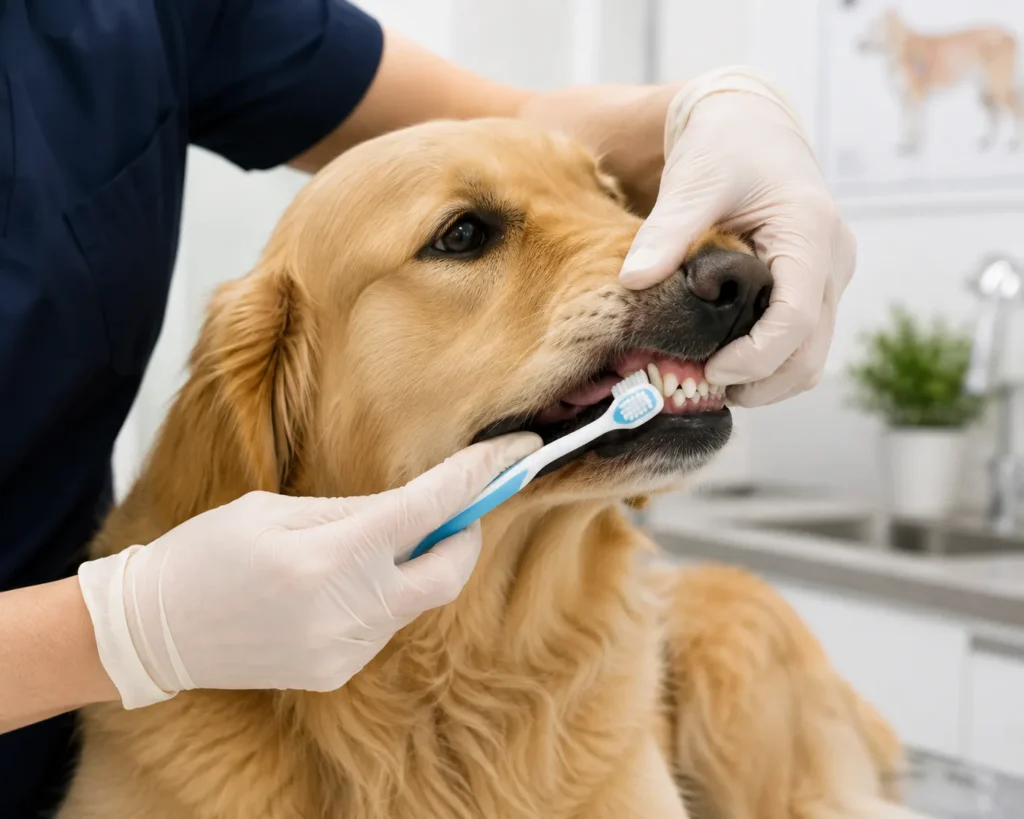
Unlike a human dental cleaning, a dog can’t be asked to sit still and open wide — which is exactly why the procedure requires general anesthesia, and why the price reflects a full surgical procedure rather than a simple scrub. That single requirement adds several components to the bill:
- Pre-anesthetic bloodwork ($50–$150) — confirms your dog is a safe anesthesia candidate
- Anesthesia administration and monitoring ($150–$350) — including a dedicated technician tracking vital signs throughout
- Full-mouth dental X-rays ($100–$250) — used to find disease hidden below the gumline, where most dental problems actually occur
- Ultrasonic scaling and polishing ($150–$400) — the actual cleaning, above and below the gumline
- Extractions, if needed ($50–$400+ per tooth) — identified from X-ray findings and typically quoted once the vet can see what’s underneath
Both the American Animal Hospital Association (AAHA) and the American Veterinary Dental College (AVDC) specifically caution against “anesthesia-free” cleanings marketed as a cheaper alternative — without anesthesia, a vet can’t safely assess or treat what’s happening below the gumline, meaning the procedure only addresses visible tartar while missing the disease that actually matters.
What Drives the Price Up or Down
- Location. Urban clinics typically run 20–40% more than rural practices for the same procedure.
- Dog size. Anesthesia cost scales with weight — roughly $150 for a small 10-lb dog versus $350+ for a 100-lb dog. Counterintuitively, this doesn’t always mean small dogs are cheaper overall: they’re often more prone to dental disease and need more extractions, which can push their total bill to match or exceed a large dog’s.
- Extractions. The single biggest cost swing in most invoices — each tooth removed adds $50–$400+ depending on complexity.
- General practice vs. specialist. A board-certified veterinary dentist charges meaningfully more than a general practice vet, but may be necessary for advanced cases.
- Severity of disease at time of cleaning. Mild tartar buildup is inexpensive to address; advanced periodontal disease with bone loss adds significant time and cost.
Why Skipping Cleanings Often Costs More Later
This is the core financial argument for staying on schedule with dental care: periodontal disease is one of the most common diagnoses in dogs over age three, and it progresses steadily if left untreated — from mild tartar to gum disease to eventual bone loss and multiple extractions. A dog that skips routine cleanings for years often ends up needing a far more complex, expensive procedure than if cleanings had continued on schedule — commonly cited as roughly $400 for routine maintenance versus $1,300+ once the disease has advanced. There’s also a quality-of-life dimension worth noting: dogs generally don’t show dental pain the way humans do, continuing to eat and behave normally even with significant disease present, which is part of why owners are often unaware anything is wrong until it’s advanced.
When Should a Dog Get Its First Cleaning?
The American Animal Hospital Association recommends a dog’s first professional dental cleaning by age 1 for small and medium breeds, and by age 2 for large breeds. After that, most dogs benefit from cleaning roughly once a year, though small breeds or dogs prone to dental disease may need it every 6–12 months, while some large breeds with strong home dental care can stretch to every 18–24 months.
Does Pet Insurance Cover Dental Cleaning?
This is a common point of confusion: standard pet insurance typically does not cover routine, preventive dental cleaning — it’s classified as wellness/preventive care, the same category as annual exams and vaccines. However, most accident-and-illness plans do cover dental disease and extractions when they result from illness or injury — meaning if your dog develops periodontal disease requiring extractions, a portion of that (often more expensive) bill can be reimbursed, even though the earlier routine cleaning wasn’t. Some insurers also offer optional wellness add-ons that specifically extend coverage to routine cleanings, for an additional monthly cost.
How to Reduce the Bill Without Cutting Corners
- Get a written, itemized estimate from two or three clinics before committing — this reveals whether X-rays, monitoring, and medications are included, and flags unusually high or suspiciously low quotes.
- Don’t choose based on price alone. A legitimate anesthetic cleaning with X-rays is worth more than a cheap surface-only polish that misses disease below the gumline.
- Stay on a regular schedule. Routine cleanings are consistently cheaper than treating advanced disease later.
- Ask about payment plans if a specialist-level bill with extractions is needed unexpectedly.
Bottom Line
Realistic budgeting for dog dental cleaning should account for $300–$800 for a routine cleaning, with total cost climbing toward $1,000–$2,000+ if extractions or specialist care are needed. Since the procedure is genuinely preventive spending — a $400 routine cleaning now is consistently cheaper than a $1,300+ bill after disease has advanced — staying on schedule is one of the more straightforward ways to manage a dog’s lifetime veterinary costs.
Frequently Asked Questions
Is anesthesia-free dog dental cleaning a safe way to save money? Both AAHA and AVDC caution against it — without anesthesia, a vet can’t safely evaluate or treat disease below the gumline, meaning the procedure only addresses visible surface tartar while potentially missing more serious underlying issues.
Does pet insurance cover extractions? Generally yes, if the extractions result from illness or injury (like periodontal disease) rather than routine preventive care, and as long as the underlying dental disease wasn’t already diagnosed before your policy started.
How often does my dog actually need a professional cleaning? Most dogs benefit from cleaning roughly once a year after their first cleaning (recommended by age 1-2 depending on size), though small breeds or dogs prone to dental disease may need it every 6-12 months.
- Dental Disease in Dogs: Stages and Real Costs
- Pet Insurance Wellness Add-On: Worth It?
- How Much Does an X-Ray for a Dog Cost Without Insurance
Sources referenced: VetReceipt (2026 reporting).