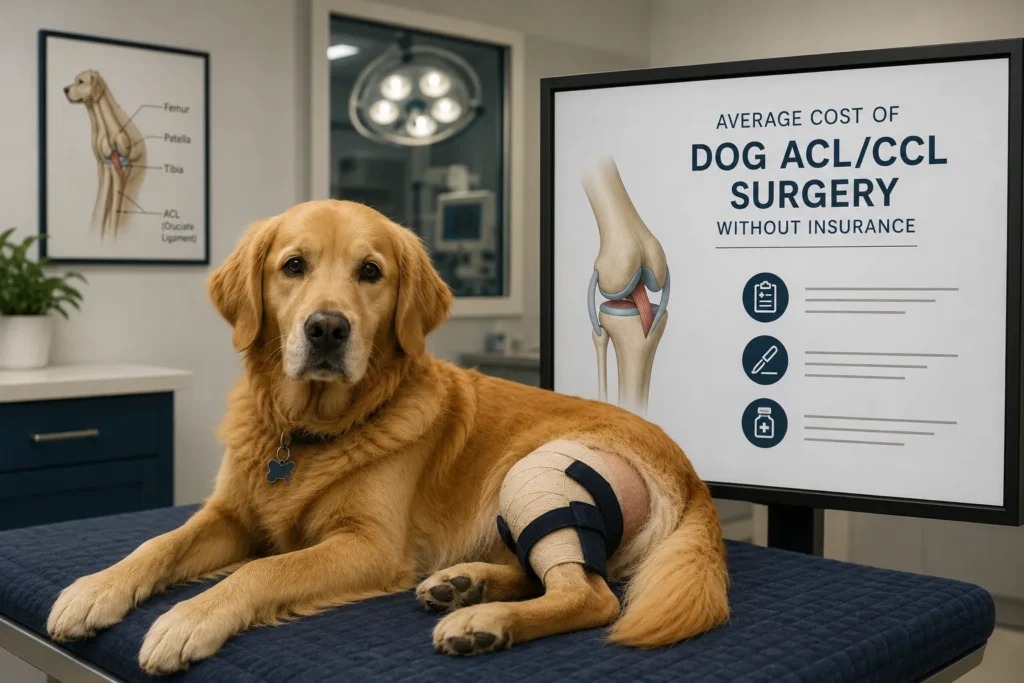
A torn ACL is one of the most common — and most expensive — orthopedic injuries a dog can face. If your dog is suddenly limping and a vet has mentioned “cruciate ligament,” here’s what you’re actually looking at financially, broken down by the surgical option your vet is likely to recommend.
What’s Actually Torn: ACL vs. CCL
Dogs don’t technically have an ACL — the term vets and owners use out of familiarity with the human injury. The actual structure is called the cranial cruciate ligament (CCL), and it serves essentially the same function as the human ACL. When it tears, most dogs require surgery to restore stability and function, since the ligament won’t heal or regrow on its own.
The Three Main Surgical Options and What They Cost
Extracapsular Suture Stabilization (Lateral Suture Repair)
The least invasive and generally least expensive option. A strong suture is placed around the outside of the joint capsule to mimic the stability the torn ligament used to provide.
- Typical cost: $1,500–$5,000
- Best suited to smaller, older, or less active dogs
- Success rates are generally higher in small dogs than large ones
Tibial Plateau Leveling Osteotomy (TPLO)
The most commonly recommended procedure for medium to large, active dogs, and generally the most expensive. The top of the tibia is cut and rotated to change the joint’s mechanics, then stabilized with a metal plate and screws.
- Typical cost: roughly $2,000–$6,000 per leg in most estimates (MetLife cites $2,000–$5,000), with some sources putting specialty-hospital cases as high as $10,000
- Offers strong long-term outcomes for larger, active dogs, though it’s the most invasive and technically demanding option
Tibial Tuberosity Advancement (TTA)
A comparable alternative to TPLO, generally similar in cost, better suited to certain joint geometries.
- Typical cost: $3,000–$6,000, sometimes overlapping with TPLO pricing depending on the case
What These Prices Do (and Don’t) Include
Quoted surgery prices typically cover anesthesia, the procedure itself, and immediate post-operative care — but not everything. Budget separately for:
- Pre-surgical diagnostics — vet exam, X-rays, bloodwork
- Pain medication, both before and after surgery
- Follow-up visits and recheck radiographs to monitor healing
- Rehabilitation — some dogs need formal physical therapy in addition to home-based exercises
Once these are factored in, total realistic cost for a single-leg surgery commonly lands somewhere in the $2,000–$7,000+ range depending on surgery type, location, and clinic — with TPLO cases in expensive metro specialty hospitals sometimes exceeding that.
The Cost Most Owners Don’t See Coming: The Second Knee
This is arguably the most important number in this entire topic: research indicates around half of dogs that tear one CCL will tear the other within about two years. That statistic transforms the financial picture significantly — a single TPLO can effectively become double the cost if both knees eventually need surgery, sometimes performed together as a bilateral procedure or staged months apart.
Does the Type of Surgery Actually Matter for Cost-Effectiveness?
Not always in the way owners initially assume. For a large, active dog, choosing the cheaper extracapsular option to save money upfront can sometimes backfire — larger or more active dogs tend to have higher complication and revision rates with less robust techniques, meaning the “budget” option can end up costing more in the long run if a second surgery becomes necessary. Vets typically match the surgical technique to the dog’s size and activity level for exactly this reason, not simply based on price.
Non-Surgical Alternatives, If Surgery Isn’t an Option
Conservative (non-surgical) management — rest, joint supplements, physical therapy, and sometimes a knee brace — is sometimes appropriate for small, older, or low-activity dogs, or in cases where surgery genuinely isn’t financially feasible. It’s generally not considered the ideal long-term solution for larger or more active dogs, but it remains a real option worth discussing directly with your vet if cost is a significant barrier.
Why This Condition Is a Strong Argument for Pet Insurance
CCL tears rank among the most common — and most expensive — reasons dogs end up needing orthopedic surgery, which is part of why several major insurers and veterinary organizations specifically recommend considering pet insurance while a dog is still healthy. Since CCL injuries are treated as an illness/injury rather than accident-only in most policy structures, and given the very real chance of a second tear in the other leg, this is exactly the kind of scenario a solid annual coverage limit and accident-and-illness plan are built to absorb — provided the policy was purchased before any limping or diagnosis occurred.
Bottom Line
Dog ACL (CCL) surgery realistically costs anywhere from $1,500 for a straightforward extracapsular repair in a small dog to $10,000+ for a TPLO in a large, active dog — and the meaningful chance of a second tear in the other leg means the true lifetime cost of this single injury category can easily double. Getting a written, itemized estimate before committing to a procedure — and asking directly what’s included versus billed separately — is the most practical way to avoid being surprised by the final bill.
Frequently Asked Questions
Is TPLO always better than extracapsular repair? Not universally — TPLO tends to offer better outcomes for larger, more active dogs, while extracapsular repair can be a perfectly reasonable and less expensive choice for smaller, older, or less active dogs. Your vet’s recommendation is typically based on your specific dog’s size and activity level, not just cost.
Does pet insurance cover ACL/CCL surgery? Generally yes, as long as the injury develops after your policy’s waiting period and wasn’t a pre-existing condition — check specifically for any bilateral condition exclusions, since a second tear in the other leg is a real possibility with this injury.
Can a dog recover without surgery? For small, older, or low-activity dogs, conservative management (rest, supplements, physical therapy, sometimes a brace) can be a reasonable option, though it’s generally not considered ideal for larger or more active dogs, who tend to do better long-term with surgical repair.
- How Much Does an X-Ray for a Dog Cost Without Insurance
- Pet Insurance for Labrador Retrievers: Common Claims and Costs
- Pet Insurance Waiting Periods, Explained
Sources referenced: MetLife Pet Insurance and PetMD (2025-2026 reporting).