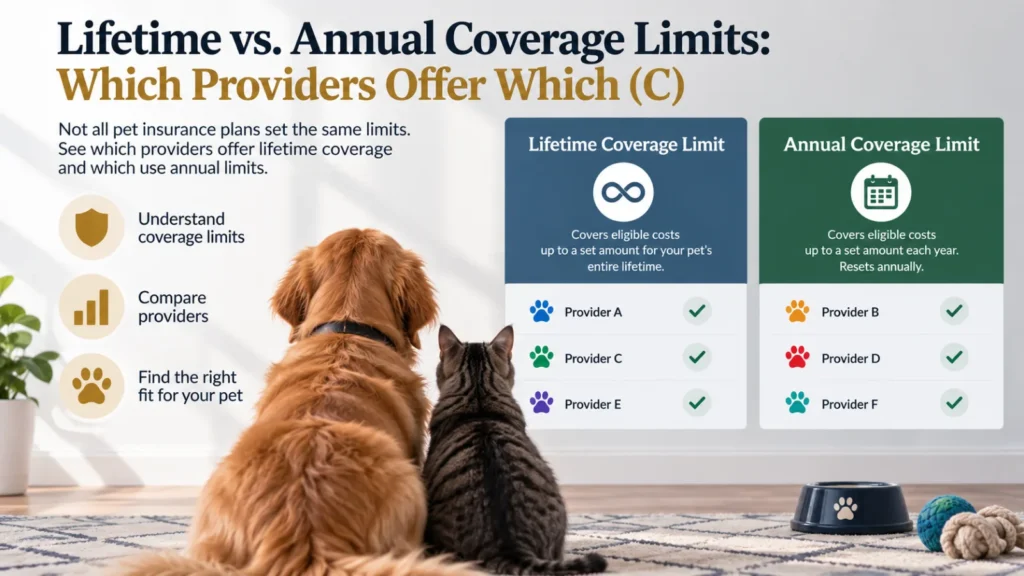
Understanding pet insurance coverage limits is one of the more consequential parts of reading a quote. Unlike deductible or reimbursement rate, this is one area where the actual providers you’re choosing between matter more than the general concept. Here’s exactly how the two pet insurance coverage limits differ, and which companies offer which.
Annual Limits: The Standard Coverage Limit Structure
An annual limit is the maximum dollar amount your insurer will reimburse for covered expenses during a single policy year, resetting fully every 12 months from your policy’s anniversary date. Say you have a $10,000 annual limit and use $8,000 of it treating an illness. You start the next policy year with the full $10,000 available again, regardless of how much you used previously. Once you hit your annual limit in a given year, you’re responsible for 100% of any additional eligible costs until the policy renews.
Annual limit tiers across the industry commonly include $5,000, $10,000, $15,000 and $25,000, according to MoneyGeek, with many providers also offering a true unlimited option at the top tier.
For more on how deductibles interact with these pet insurance coverage limits, see our guide to annual vs. per-incident deductibles.
Lifetime Limits: The Coverage Limit That Never Resets
A lifetime limit is a permanent maximum your insurer will ever pay out for your pet, accumulated across the entire time you hold the policy. Unlike an annual limit, this doesn’t reset. Once you reach it, your coverage effectively ends for good, even if that happens early in your pet’s life. Lifetime limits stay less common than annual limits in 2026’s market, since most major insurers have shifted toward either capped annual limits or genuinely unlimited coverage rather than a fixed lifetime ceiling.
Which Providers Offer Unlimited Pet Insurance Coverage Limits
This detail is worth knowing directly, since “unlimited” isn’t offered by every insurer, and it’s a meaningful differentiator when comparing quotes. According to Pawlicy Advisor’s 2026 rankings, top-rated companies like ASPCA, Figo, and Pumpkin offer comprehensive coverage with unlimited annual payout options, alongside providers like Fetch, Prudent Pet, Embrace, Healthy Paws, and Trupanion.
A few of these stand out for specific reasons:
- Healthy Paws — long associated with unlimited coverage; it now lets you customize your annual limit, with choices that include no payout limit, so confirm the option on your quote.
- Trupanion — pairs unlimited coverage with a flat 90% reimbursement rate on every plan and no per-condition or lifetime payout caps, though it uses a per-condition deductible structure rather than the standard annual deductible.
- Figo — commonly grouped alongside Trupanion and Healthy Paws as offering genuinely unlimited lifetime benefits.
What “Unlimited” Actually Does — and Doesn’t — Mean for Your Coverage Limits
This point is worth stating clearly, since “unlimited” can sound like it means something broader than it does. Unlimited coverage removes the dollar ceiling on eligible expenses. It does not remove your deductible, coinsurance, waiting periods, exclusions, or pre-existing condition rules. Routine care, elective procedures, wellness services, and any specifically excluded condition remain outside the policy regardless of whether your annual limit is $5,000 or unlimited. An unlimited policy still requires you to meet your deductible and pay your reimbursement-rate share on every claim. It simply means no dollar ceiling stops additional eligible claims from getting covered within the same policy year.
The Real Cost of Upgrading Your Pet Insurance Coverage Limits
Higher limits cost more, and the increments are worth knowing before you assume unlimited is always the better choice. According to MoneyGeek’s annual limits guide, moving from a $5,000 to a $10,000 limit might add $10 to $20 a month, and unlimited coverage could add $20 to $40 more, since insurers price in the possibility of high-cost claims like cancer treatment or orthopedic surgery. Whether that’s worth it depends heavily on your specific pet’s risk profile. A young, low-risk mixed-breed dog may rarely approach even a $5,000-$10,000 annual limit, while a breed with elevated cancer or orthopedic risk could plausibly exceed it in a single serious diagnosis.
When a Capped Annual Limit Is Genuinely Enough
- Your pet is young, low-risk, and from a breed without major documented hereditary conditions.
- Local veterinary costs in your area are moderate, meaning even a serious diagnosis is less likely to approach a $10,000-$15,000 ceiling.
- You have some emergency savings as a backstop in case a rare, exceptionally expensive event does exceed your chosen limit.
When Unlimited Coverage Is Worth the Extra Premium
- Your pet’s breed carries elevated risk of an expensive chronic or catastrophic condition — cancer-prone breeds, large breeds with orthopedic risk, or breeds with known cardiac conditions are the clearest cases.
- You live in a high-cost veterinary market, where even routine emergency care runs meaningfully higher than the national average.
- You’d rather pay a predictable, somewhat higher premium than risk a scenario where a capped limit leaves you covering a five-figure balance yourself.
How to Compare Pet Insurance Coverage Limits Across Providers
- Confirm whether a specific plan’s “unlimited” applies to the annual limit, the lifetime limit, or both. These aren’t always synonymous, and a plan can be unlimited annually while still applying some other structural cap.
- Check the deductible structure alongside the limit type. An unlimited-payout plan with a per-condition deductible, like Trupanion’s, behaves differently than one with a standard annual deductible. Understand both together, not the limit type in isolation.
- Ask directly what remains excluded even under an unlimited plan. Unlimited removes the dollar ceiling, not the underlying exclusions and pre-existing condition rules that still apply to every policy regardless of limit type.
Bottom Line on Pet Insurance Coverage Limits
Annual limits reset every policy year and stay the more common structure industry-wide, ranging from as low as $2,500 up to fully unlimited depending on the provider. Lifetime limits, by contrast, never reset and have become less common as more insurers shift toward either capped annual limits or genuine unlimited coverage. ASPCA, Pumpkin, Spot, MetLife, Fetch, Prudent Pet, Figo, Embrace, Healthy Paws, and Trupanion all offer some form of unlimited coverage as of 2026. Prioritize this in your comparison if your pet’s breed or your local vet costs make a capped limit a real concern, while remembering that “unlimited” only removes the dollar ceiling, not the deductible, exclusions, or pre-existing condition rules underneath it.
Frequently Asked Questions
If my pet reaches its annual limit, does coverage end permanently? No. An annual limit resets fully at your next policy renewal, typically every 12 months. A lifetime limit, by contrast, is the one that ends coverage permanently once reached.
Does unlimited coverage mean I’ll never pay anything out of pocket? No. You’ll still pay your deductible and your reimbursement-rate share (coinsurance) on every eligible claim. Unlimited only removes the dollar ceiling on how much the insurer will pay across a policy year (or lifetime), not your ongoing cost-sharing.
Is it worth paying extra for unlimited coverage if my pet is young and healthy? It depends mainly on breed risk and local vet costs rather than current health status. A young, low-risk mixed breed in a moderate-cost area may do fine with a capped $10,000-$15,000 limit, while a breed with known elevated cancer or orthopedic risk makes a stronger case for paying extra when comparing pet insurance coverage limits.
Sources referenced: MoneyGeek.