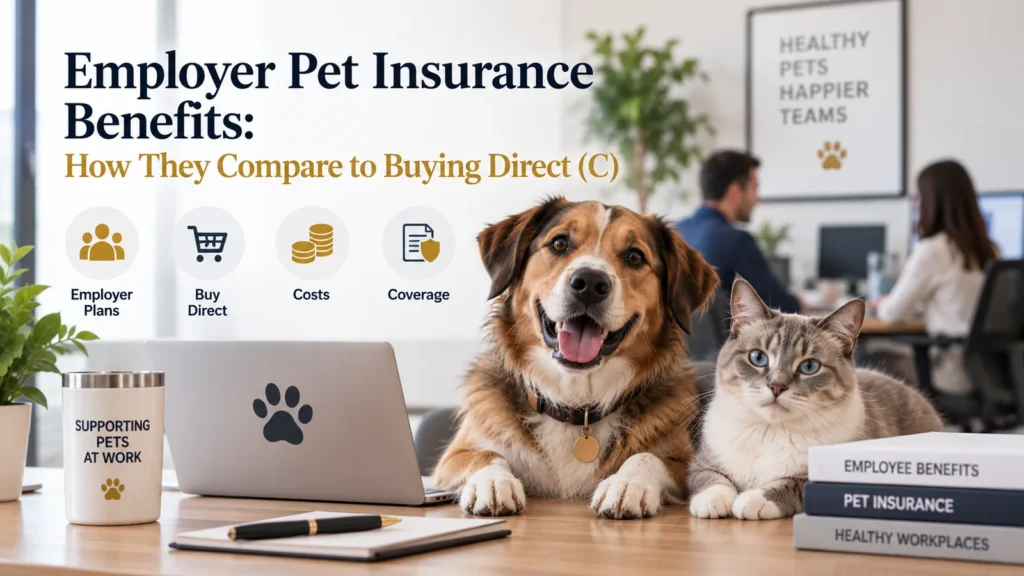
Pet insurance has quietly become one of the fastest-growing voluntary employee benefits. SHRM’s Employee Benefits Survey found that 22% of organizations now offer it, up from 14% in 2022, as ExtensisHR reports. Benefits professionals increasingly describe it as approaching “must-have” status. But does a workplace plan actually beat buying directly on your own? The honest answer: usually similar, with one genuinely distinctive exception worth knowing about.
Employer vs Direct Pet Insurance: The Core Discount Advantage
Employer-sponsored pet insurance typically comes with a 5-10% discount off standard retail pricing. MoneyGeek’s pet insurance discounts guide puts employee group discounts at often 5% to 10% off standard premiums. Insurers usually structure this as a group or affinity rate. It works similarly to a multi-pet discount, but your employment relationship triggers it rather than owning multiple pets. It’s a real savings, but a modest one. It doesn’t match the dramatic discounts some other voluntary benefits, like certain group life insurance products, can offer.
The One Genuinely Distinctive Benefit: Pre-Existing Condition Transfer
This benefit is worth highlighting because it’s rare in the pet insurance industry. It’s worth actively seeking out if it’s available to you. MetLife’s employer group pet insurance plans can, in specific cases, cover pre-existing conditions that another provider already covers. This only applies to employees purchasing MetLife Pet Insurance through an employer group benefit, not through a direct individual purchase.
In practice, this means something specific. Say you’re already insured elsewhere, and your cat’s diabetes or your dog’s allergies currently have coverage under that existing policy. Switching to a MetLife employer plan could preserve that coverage. Standard pre-existing condition rules would otherwise reset it entirely (see our guide to how pre-existing conditions are defined for how significant a departure this is from the industry norm). The employer-group structure specifically ties to this benefit. It generally isn’t available if you buy the same MetLife policy directly as an individual.
How Payment Structure Differs Between Employer and Direct Plans
Employer plans typically use payroll deduction rather than a direct monthly charge to your card or bank account. Benefits consultants report that payroll deduction generally increases participation compared to direct billing. The predictability and reduced friction of automatic deduction largely explain this, though some employers also offer direct billing as an alternative. The underlying policy and coverage terms are usually identical to what you’d get buying the same product directly. Only the payment mechanism changes.
Does Coverage Quality Actually Differ?
Generally, no. An employer-sponsored pet insurance plan is typically the same underlying insurance product you could buy directly from the same carrier. You simply access it through a workplace enrollment channel with a modest discount applied. The coverage categories, exclusions, and claims process are usually identical to the direct-purchase version. The MetLife pre-existing condition transfer benefit above is the clearest exception to that general rule.
What to Actually Compare Before Choosing Employer vs Direct Pet Insurance
- Check which specific insurer your employer partners with. The discount and any special terms only apply to that carrier’s plan, so it’s still worth comparing that insurer against others on the open market for coverage breadth, claims speed, and price (see our broader insurer comparison for how the major carriers stack up).
- Check whether you’re currently insured elsewhere with an active pre-existing condition covered. If so, and your employer specifically offers MetLife, investigate the transfer benefit directly rather than assuming a switch would reset your pet’s coverage from scratch.
- Weigh the size of the actual discount. A 5-10% discount is worth taking if the underlying policy is competitive, but it shouldn’t be the deciding factor if a different carrier offers meaningfully better coverage or claims experience for a similar net price.
- Consider your payroll deduction vs. direct billing preference. Some employees value the “set it and forget it” simplicity of payroll deduction, while others prefer managing the payment directly.
When Buying Direct Might Still Make More Sense
- Your employer’s partnered insurer isn’t a strong overall fit for your pet’s needs. A 5-10% discount rarely outweighs meaningfully better coverage or a shorter waiting period elsewhere.
- You want more flexibility in choosing deductible, reimbursement rate, or annual limit combinations. Employer plans sometimes offer fewer customization options than a direct purchase.
- You’re not currently facing the specific pre-existing condition transfer scenario MetLife’s employer benefit addresses. In that case, the main advantage narrows to the standard discount, which a comparable direct policy’s pricing might already offset.
Why This Benefit Category Is Growing So Quickly
Beyond the direct financial comparison, it’s worth understanding why employers are adding this benefit fast. This trend affects how likely you are to have this option in the first place. A 2025 Wagmo survey found that 75% of working pet parents say their pet’s health directly affects their stress levels at work. HR professionals increasingly view pet benefits as a low-cost, high-visibility way to support employee wellbeing. In a PetPartners survey of HR professionals cited by WorldatWork, 87% agreed that offering pet insurance is a good way for a company to show it cares about its employees. If your employer doesn’t currently offer it, mention this growing trend if you’re advocating for it. Many benefits consultants note employers can implement it at little to no direct cost.
Bottom Line: Employer vs Direct Pet Insurance
An employer-sponsored pet insurance plan is typically the same product available for direct purchase. It comes with a modest 5-10% discount and the convenience of payroll deduction. That’s genuinely useful, but usually not dramatic enough to override a stronger direct option elsewhere. The one real exception worth checking for: your employer offers MetLife specifically, and you already have a pet with a covered pre-existing condition under another insurer. In that case, the employer-group transfer benefit offers a distinctive feature unavailable through a standard direct purchase. It’s worth investigating directly with your HR benefits team before assuming a switch would mean starting your pet’s coverage history over from zero.
Frequently Asked Questions
Is an employer pet insurance plan always cheaper than buying the same policy directly? Usually somewhat cheaper, thanks to the typical 5-10% group discount. It’s the same underlying policy in most cases, though, so compare it against other direct-purchase carriers rather than assuming the employer option is automatically the best value.
Can I ask my employer to add pet insurance if they don’t currently offer it? Yes. At least one major insurer specifically encourages this approach. Employers can typically add this voluntary benefit inexpensively, so it’s a reasonable request to bring to HR, even without a guarantee they’ll add it.
Does the MetLife pre-existing condition transfer benefit apply if I buy MetLife directly instead of through my employer? No. This specific benefit ties to purchasing MetLife Pet Insurance through an employer group offering. It generally isn’t available through a standard individual direct purchase of the same policy.
Sources referenced: ExtensisHR (SHRM survey), MoneyGeek, Business Wire (Wagmo survey), and WorldatWork (2025-2026 reporting).