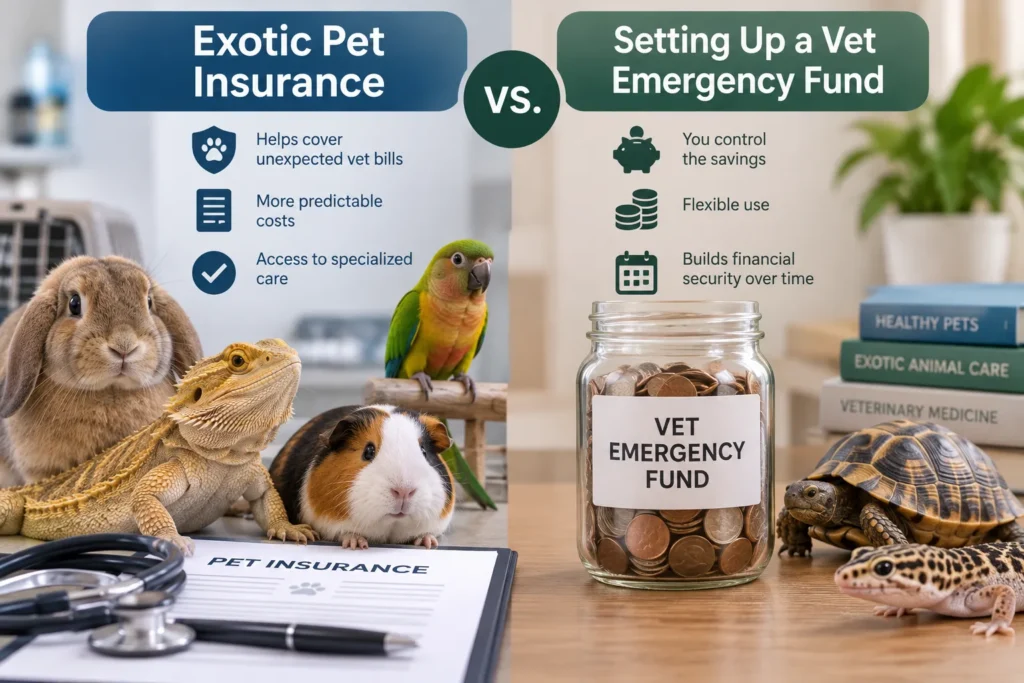
For dog and cat owners, this is a well-worn debate. For exotic pet owners, the exotic pet insurance vs savings decision comes with an extra wrinkle that changes the calculation entirely: your pet’s expected lifespan matters as much as the cost of any single emergency. A savings-first approach that makes perfect sense for a hamster can be genuinely risky for a parrot, even though both count as “exotic pets” by insurance standards.
What Exotic Emergencies Actually Cost
Before comparing strategies, it helps to ground the discussion in real numbers, since these aren’t trivial expenses:
- Avian emergency: $500-$2,000.
- Ferret adrenal surgery: $500-$2,500.
- Rabbit GI stasis treatment: $500-$1,500+, with more severe cases running higher.
- Reptile impaction surgery: can reach $400-$3,800.
MoneyGeek’s 2026 exotic pet insurance analysis confirms these are exactly the kind of unpredictable, moderate-to-large costs insurance gets designed to absorb. The real question is whether insurance is actually the most efficient way to do that for your specific exotic pet.
The Savings Approach: How It Works
Setting aside roughly $15-$30 a month, comparable to what an insurance premium would cost, into a dedicated account builds a self-funded reserve over time. After 2 years at $20/month, for example, you’d have $480 available. This approach has one core advantage: unused funds remain yours and earn interest, unlike an insurance premium, which is gone whether you file a claim or not.
The core disadvantage is the same one that applies to any self-insurance strategy. If a major expense occurs before the fund has had time to grow, you’re exposed to the full cost out of pocket.
Why Your Pet’s Lifespan Changes Everything in the Exotic Pet Insurance vs Savings Decision
This detail makes the exotic-pet version of this comparison genuinely different from the dog-and-cat version.
For Short-Lived Species (Hamsters, 2-3 Years)
A savings approach can work well here. The exposure window, the period where you’re vulnerable to a major expense before your fund has grown, covers a meaningful chunk of the pet’s entire life. But the total dollar amount at risk also stays naturally capped by how briefly these pets typically live and how limited the scope of major treatable conditions tends to be.
For Long-Lived Species (Parrots, Decades)
The risk exposure during the initial saving period runs significant. A large parrot can live 50+ years, meaning even a slow, disciplined savings approach spends its early years in a genuinely vulnerable state relative to the total lifetime risk being managed. Avian emergencies alone can run $500-$2,000, and birds are notoriously skilled at hiding illness until a condition is already serious, making sudden, large bills more likely than a gradual, budgetable decline. Insurance’s immediate full-coverage protection, once your waiting period ends, carries more relative weight for a species with this kind of lifespan.
The General Case for Insurance
- Immediate protection. Once your waiting period passes, you’re covered for the full range of eligible conditions, with no multi-year buildup required.
- Predictable monthly cost. You know exactly what you’re paying, rather than needing the discipline to consistently self-fund.
- Removes the “can I afford this” hesitation at the exact moment your pet needs care, since the financial decision already got made when you enrolled.
The General Case for a Savings Fund
- No exclusions, no waiting period, no claims process. You decide what counts as a valid expense.
- Funds you don’t use stay yours. Money in a high-yield savings account, potentially earning 4-5% APY, keeps growing rather than disappearing into premiums for coverage you never used.
- No pre-existing condition problem. Since you’re not filing a claim against a policy, no concept of an excluded condition applies. This can matter more for exotic pets, given how limited insurer options already are and how easily a condition might already show mild signs by the time you seek coverage.
- Complete flexibility on which vet or treatment to pursue, without a reimbursement structure shaping the decision.
Why the Market Itself Nudges the Decision
This point is worth stating plainly for exotic pet owners specifically: insurer options stay narrow. The Zebra confirms that Nationwide remains the only insurance company currently offering coverage for avian and exotic pets, though MoneyGeek notes MetLife also covers some exotic species in select states. The “shop around for the best rate” strategy that dog and cat owners rely on doesn’t really apply here. This narrower market partly explains why many exotic pet owners lean toward a savings-first approach by default, not necessarily because the math clearly favors it, but because there’s less to actually compare and less competitive pressure keeping premiums low.
A Practical Way to Decide
- Estimate your specific pet’s realistic lifespan. A hamster and a tortoise are both “exotic,” but the planning horizon is nothing alike.
- Check whether insurance is even available for your species. If it’s not, true for some smaller or less common exotic pets, the decision is effectively made for you, and a dedicated fund becomes the only real option.
- If insurance is available, compare the monthly premium against what you’d need to save monthly to reach a reasonable emergency threshold, roughly matching the higher end of the cost ranges above, within your pet’s first year or two of life.
- Factor in how well your specific species hides illness. Birds and reptiles both stand out at masking symptoms, which tends to favor having full coverage in place early rather than relying on a fund that hasn’t yet grown when a hidden condition finally surfaces.
The Middle Path: Doing Both, Modestly
Just as with mainstream dog and cat coverage, nothing requires an all-or-nothing choice. A modest ongoing contribution to a dedicated fund, even a small amount, can cover a policy’s deductible and any routine costs insurance won’t touch, while the policy itself absorbs the larger, less predictable risk. For exotic pets specifically, this hybrid approach can be a reasonable way to manage the narrower insurance market without taking on full self-insurance risk during a long-lived pet’s early years.
Bottom Line: Exotic Pet Insurance vs Savings
For exotic pets, the insurance-versus-savings decision hinges more heavily on species lifespan than it does for dogs and cats. A savings-first approach is a genuinely reasonable strategy for short-lived pets like hamsters, where the total lifetime risk window stays naturally limited. For long-lived species like parrots, the extended vulnerability period during a fund’s early growth years, combined with how skilled birds are at hiding illness, tips the math more clearly toward having insurance coverage in place from the start, even given how narrow the exotic pet insurance market currently is.
Frequently Asked Questions
Is a savings fund ever a bad idea for a short-lived exotic pet? It can still leave you exposed if a major expense happens very early, before the fund has grown. But given how brief these pets’ lives typically are, the total dollar risk being managed stays naturally smaller than for a long-lived species.
What if insurance isn’t available for my specific exotic pet at all? A dedicated savings fund becomes your primary option by default in that case. Start as early as possible, since no alternative financial protection exists for species outside the current insurance market.
Does combining a savings fund with insurance make sense for exotic pets? Yes, for many owners. A modest fund can cover your policy’s deductible and any routine costs insurance excludes, while the policy itself handles the larger, harder-to-predict risk. That’s a reasonable middle path given how limited exotic pet insurer options currently are.
- Guinea Pig Insurance: Is It Worth It?
- Rabbit Insurance: Is It Worth It in 2026?
- Pet Insurance vs. Pet Savings Account: Which Saves You More Money
Sources referenced: MoneyGeek and The Zebra (2025-2026 reporting).